
AI can now do most of the work between a keyword and a published article. Research, planning, drafting, checks and formatting all move faster than any team could manage by hand.
That does not make content strategy a button. It moves the work. When writing stops being the bottleneck, the two decisions that were always more important become impossible to ignore: what your business should own, and whether what comes back deserves your name.
Here is how the eight stages break down, and who should own each one.
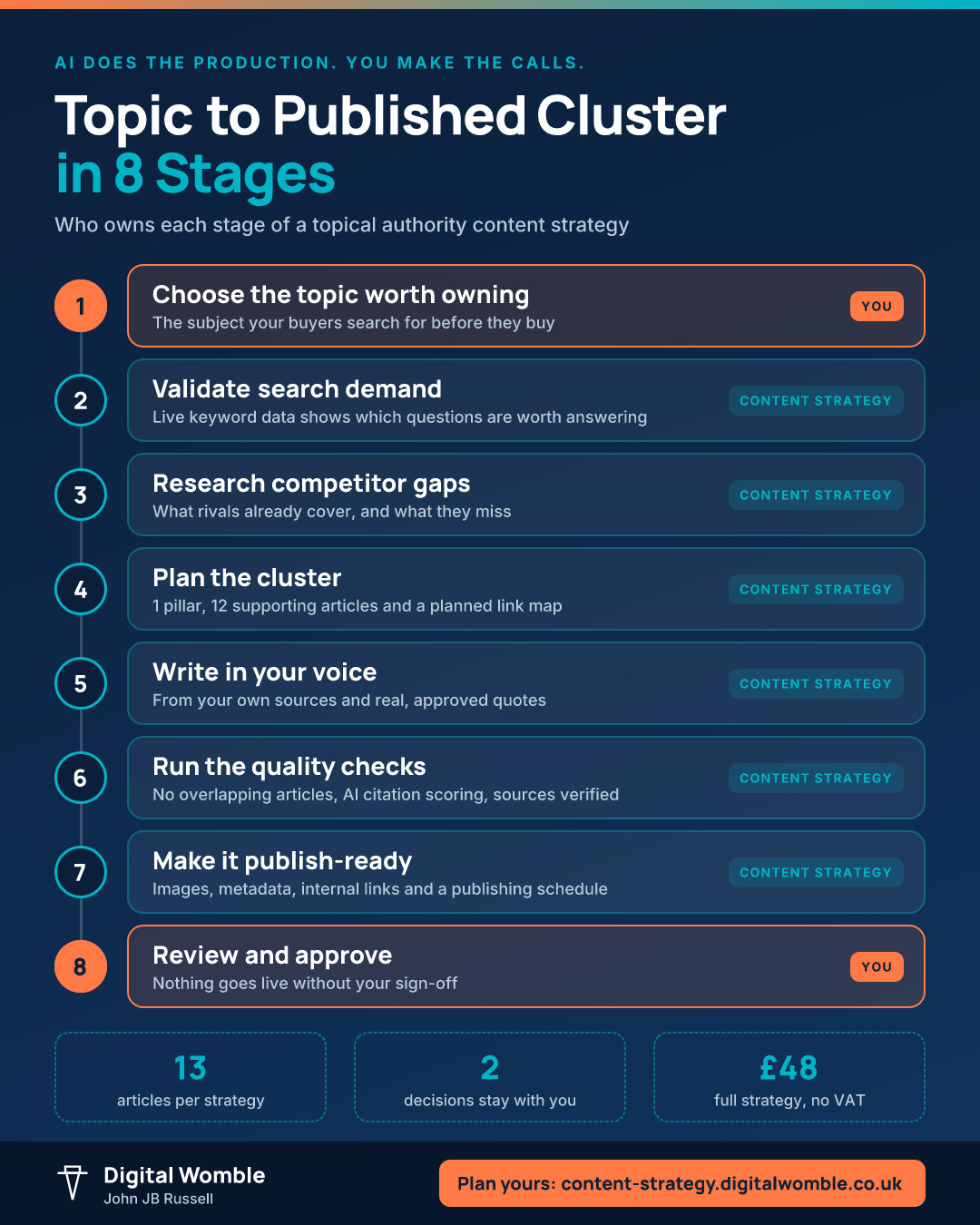
The 8 stages from topic to published cluster
- Choose the topic worth owning. You. The subject your buyers search for before they buy, and one your business can credibly lead on.
- Validate search demand. Content Strategy. Live keyword data shows which questions are worth answering and which only look attractive.
- Research competitor gaps. Content Strategy. What rivals already cover, how they structure it and what they leave out.
- Plan the cluster. Content Strategy. One pillar article, twelve supporting articles and a planned internal link map, so every page has a job.
- Write in your voice. Content Strategy. Drafts built from your own sources and real, approved quotes rather than the internet's average.
- Run the quality checks. Content Strategy. No two articles competing for the same search, each article scored on whether an AI assistant would cite it, and any source that cannot be verified is left out.
- Make it publish-ready. Content Strategy. Images, metadata, internal links and a publishing schedule.
- Review and approve. You. Nothing goes live without your sign-off.
Google's people-first content guidance is a useful editorial test: the page should add original value for its intended audience rather than exist mainly to capture search visits. That is why depth, evidence and a coherent internal journey matter alongside keyword targeting.
Stage 1 is where most content fails
A machine given a poor topic will execute it quickly and well, and still take you nowhere. Choosing the topic is a commercial decision: which subject leads to enquiries, which one your site can realistically win, and which one simply attracts readers who will never buy.
That judgement depends on knowing your margins, your best customers and the conversations your sales team has every week. No keyword tool has that information. Your business does.
Stages 2 to 7 are production
The middle of the process is where AI has changed the economics. Demand research, competitor analysis, outlining, drafting and technical checks used to consume most of a content budget. They are now the fastest part.
That only works when the inputs are good. The drafts are only as specific as the sources, quotes and business detail you provide, which is why the brief matters more than it ever has.
Stage 8 protects your name
Every claim about your business, every figure and every quote needs a person who knows the business to confirm it. Publishing unchecked content at speed is the fastest way to lose the trust that topical authority is supposed to build.
What this means for your team
The time saved in the middle should go to the ends. Spend longer choosing what to own. Spend longer reviewing what comes back. Those are the stages that decide whether content wins business or just fills a blog.
Plan your own cluster
Topical Authority Content Strategy runs stages 2 to 7 for you. You choose the topic, review the result and approve what goes live. You can start with a free complete pillar article plus a 12-title supporting strategy preview, and the full 13-article strategy is £48, no VAT.
Share this infographic
You are welcome to use the infographic on your own site, as long as it links back to this page. Copy this code:
<a href="https://digitalwomble.co.uk/blog/ai-content-strategy-8-stages"><img src="https://digitalwomble.co.uk/infographics/topic-to-published-cluster-8-stages.jpg" alt="Topic to Published Cluster in 8 Stages, by Digital Womble" width="1080" height="1350" loading="lazy"></a>
<p>Infographic by <a href="https://digitalwomble.co.uk/blog/ai-content-strategy-8-stages">Digital Womble</a></p>
Key takeaways
- A topical authority content strategy runs through eight stages from topic to published cluster.
- AI can own the six production stages in the middle.
- Choosing the topic and approving the result should always stay with the business.
- The better your brief, sources and quotes, the better the production stages perform.
Apply the idea without creating more noise
Start with the page's actual job and the reader's next decision. Check the evidence already available, identify the gaps preventing that decision, and improve those before adding another page or campaign. A useful change should make the journey clearer, not simply make the estate larger.
Measure the result against a baseline. For informational content that may mean qualified impressions, clicks and progression to a relevant commercial page; for commercial content it should extend to enquiries, sales or another meaningful conversion. This keeps optimisation tied to business value rather than publishing volume.