Google Ads agency proof · specific periods · anonymised where appropriate

Google Ads Agency Results: What Improved, When, and By How Much

A Google Ads agency should be able to show more than account screenshots and generic claims. This page documents specific improvements from live client accounts using the timeframe and metric that best reflects the change: conversions, cost per conversion, CTR, CPC, spend efficiency and revenue where the tracking supports it.

Anonymised Google Ads results across four client types

Selective, dated examples. They are not lifetime averages or performance guarantees.

Four different proof types, not four versions of the same claim

Some accounts have revenue attribution. Others have stronger evidence in conversion efficiency, click quality or cost control. We use the strongest metric the account can genuinely support rather than forcing every case into a ROAS story.

Professional services · June to July 2026

Tracked conversions up 83%

  • Cost per conversion down 45%
  • Average CPC down 29%
  • Spend essentially flat

A month-on-month comparison from a live account. The point is efficiency: materially more tracked conversions without materially higher spend.

B2B telecoms · July to August 2026

CTR up 74%

  • Average CPC down 26%
  • Spend down 24%
  • Clicks slightly higher

Useful proof where revenue tracking is incomplete: stronger engagement and lower click cost while total media spend fell.

Beauty / ecommerce · June to July 2026

42% more paid-search clicks

  • Average CPC down 29%
  • CTR up 18%
  • Spend broadly unchanged

A traffic-efficiency example. Conversion tracking was not strong enough to support a revenue claim, so this case is deliberately limited to the metrics the account can substantiate.

Local service provider · Specific campaign period

£29–£47 estimated service revenue per £1 ad spend

  • £843 Google Ads spend
  • 67 attributed new customers
  • Estimated £24.3k–£39.7k service revenue

The detailed revenue methodology and caveats are documented in the dedicated local-service case study.

One account, four useful windows

Why the same local-service account can tell more than one performance story

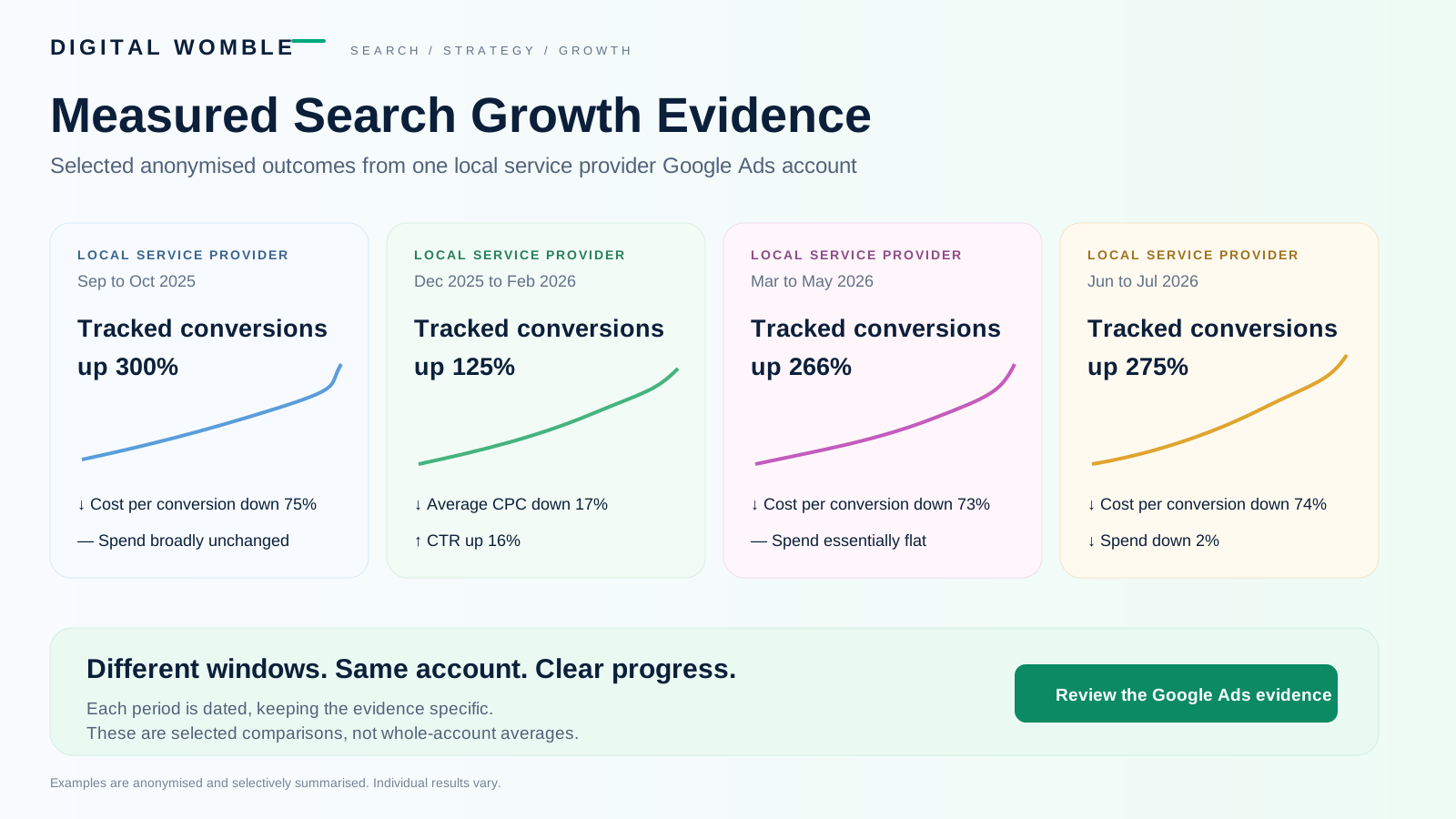
A single full-period average can flatten meaningful changes. The account below contains several discrete periods where tracked conversions increased or cost efficiency improved. Each comparison is labelled with its dates so the claim stays bounded to that period.

Sep to Oct 2025

Tracked conversions up 300%

Cost per conversion down 75% · Spend broadly unchanged

Dec 2025 to Feb 2026

Tracked conversions up 125%

Average CPC down 17% · CTR up 16%

Mar to May 2026

Tracked conversions up 266%

Cost per conversion down 73% · Spend essentially flat

Jun to Jul 2026

Tracked conversions up 275%

Cost per conversion down 74% · Spend down 2%

Four selective performance windows from one anonymised local service provider Google Ads account

What a Google Ads agency should inspect beyond headline CTR

The account review process is wider than any one metric. A high CTR can still be commercially weak, and a lower CTR can be acceptable if the clicks are more qualified. The useful question is whether the account is capturing buyer demand efficiently.

Search-term quality

Which queries are actually consuming spend, and how much of that demand is commercially relevant?

Negative-keyword control

Are irrelevant jobs, research, consumer, geographic or informational searches being excluded quickly enough?

Keyword overlap and cannibalisation

Are multiple keywords or ad groups competing for the same intent and fragmenting data or budget?

CPC and CPA movement

Is click cost falling because relevance improved, and is cost per conversion moving in the right direction?

Visibility constraints

Is impression share being lost because of budget, rank or account structure, and is that loss worth addressing?

ROAS and conversion value

Where revenue tracking is reliable, does the account produce acceptable commercial return rather than simply low-cost clicks?

Negative keywords are part of the proof

The connected accounts contain substantial negative-keyword libraries designed to stop irrelevant demand consuming budget. Examples include job-seeker terms, free and cheap searches, irrelevant countries, consumer queries against B2B offers, informational medical searches, competitor noise and product searches that do not match the advertiser's offer.

That matters because Google Ads performance is not just about finding more traffic. It is also about refusing to pay for demand that has little chance of becoming revenue.

Frequently asked questions

Why show selected time windows instead of whole-account averages?

Whole-account averages often hide where a change actually worked. Digital Womble uses specific dated comparisons when they reveal a clear improvement, and labels the timeframe so the result is not presented as if it applied to every month.

Are these Google Ads results guaranteed?

No. Results vary by market demand, offer, budget, competition, conversion tracking, landing pages and sales process. These examples show what happened in specific accounts and time periods, not what every advertiser should expect.

Do you only focus on CTR and CPC?

No. CTR and CPC are useful only when they help explain commercial efficiency. Reviews also examine conversions, cost per conversion, ROAS where revenue data exists, search-term quality, negative keywords, wasted spend, impression-share constraints and account structure.

Can Digital Womble review my existing Google Ads account without changing it?

Yes. The Google Ads Account Review uses read-only access and produces a prioritised recommendation brief. No campaign changes are made without written approval.

Want to know what is working and what is leaking in your account?

Start with a read-only Google Ads Account Review. We inspect spend, search intent, negative keywords, CPC, conversion efficiency and the account structure, then return a prioritised action plan. No changes are made without approval.