I have worked in search for twenty-seven years. In that time the tactics have been rewritten perhaps a dozen times, but the underlying question has never changed once: can the right person find you at the moment they are ready to act, and does what they find make them buy?
Most SEO guides answer a narrower question. They teach you to rank. Ranking is not the goal. Ranking is a proxy for the goal, and in 2026 it is a weaker proxy than it has ever been, because a growing share of buying journeys now start inside an AI answer rather than a list of ten blue links.
So this guide covers the basics properly, and then covers the part almost nobody teaches: what to do when the traffic arrives and does nothing.
If you would rather see where your own site stands before you read three thousand words, run the Digital Womble Scorecard first. It benchmarks your search visibility, content authority and technical infrastructure in a few minutes, and the rest of this guide will make considerably more sense with your own numbers in front of you.
Key takeaways
- SEO is no longer one system. You are optimising for a search engine that ranks pages and an answer engine that retrieves and cites passages. The work overlaps, but it is not identical.
- The order of operations matters more than the tactics. Demand, then indexation, then understanding, then authority, then conversion. Fixing step four while step two is broken is the single most common waste of budget I see.
- Keyword volume is a vanity input. Intent is the commercial input. A keyword with 200 searches a month from buyers beats one with 8,000 from researchers, every time.
- Technical SEO is not optional plumbing. If a page is not indexed it cannot rank, cannot be cited by an AI assistant, and cannot earn a penny.
- SEO compounds. It also decays. The businesses that win treat it as an operating system, not a project with an end date.
1. What SEO basics actually mean in 2026
SEO stands for search engine optimisation: the practice of making your website easy for search engines to find, understand and trust, so that people looking for what you sell arrive without you paying for each click.
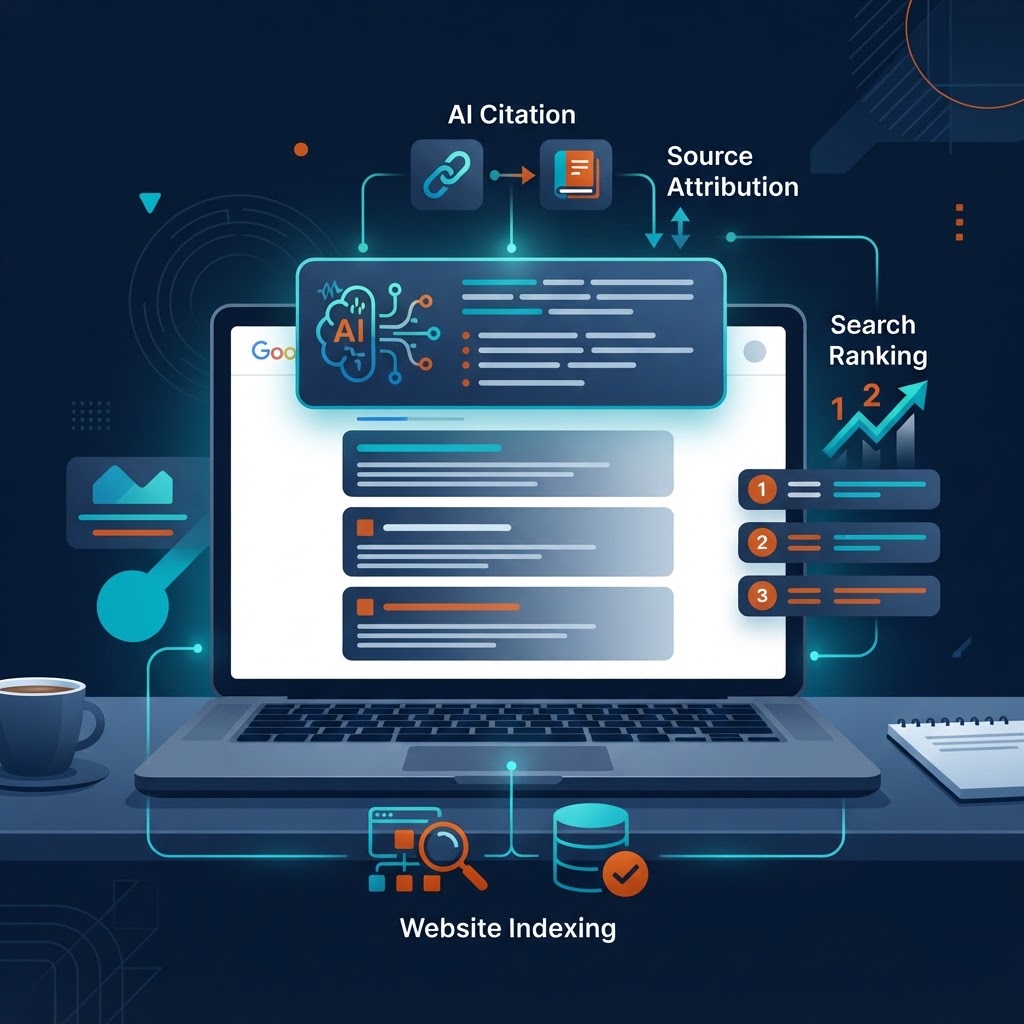
That definition still holds. What has changed is the destination. When someone asks a question today, the answer may appear as a ranked list on Google, as an AI Overview above it, or as a synthesised response inside ChatGPT, Claude, Gemini or Perplexity that names two or three businesses and never shows a list at all.
The short version: SEO basics are the foundational practices that make a website discoverable, understandable and credible to both search engines and AI answer engines. They break down into demand research, technical indexation, on-page clarity, off-site authority, and the conversion quality of the traffic that results.
The practical consequence is this. You are no longer only competing for a position. You are competing to be the source a machine chooses to summarise. Those two goals share most of the same foundations, which is good news for anyone starting out, because the fundamentals below serve both.
2. How search engines and answer engines actually work
Four stages. Skip any one of them and everything downstream fails quietly.
Crawling
Automated programs follow links and read sitemaps to discover URLs. If nothing links to a page and no sitemap lists it, it may as well not exist.
Indexing
Crawled does not mean indexed. The engine evaluates the page and decides whether it is worth storing: is it substantive, is it unique, is it technically accessible, does it duplicate something already held? Thin, duplicated or canonically confused pages get dropped here. This is the stage most business owners have never heard of and it is where most invisible revenue is lost.
Ranking
For a given query, the index is scanned and results are ordered by relevance, authority and user experience signals. Hundreds of factors, but the basics in this guide address the ones with real leverage.
Retrieval and citation
The newer stage. An answer engine pulls passages from indexed sources, synthesises them, and attributes some of them. Being retrievable rewards clear structure, unambiguous claims, defined entities and content that answers a question completely in one place rather than teasing a click.
The short version: search works in four stages: crawling (discovery), indexing (storage and evaluation), ranking (ordering), and retrieval (selection for AI-generated answers). SEO basics address all four. Indexation is the gate, and it fails silently.
Where to start: run a free Google index check on your domain. If a meaningful proportion of your pages are not in the index, stop reading about title tags and fix that first. Nothing else you do will matter until it is fixed.
3. The three classic types of SEO, and the two everyone forgets
| Layer | What it covers | Priority | |---|---|---| | Technical SEO | Crawlability, indexation, speed, mobile, Core Web Vitals, structured data | Do first | | On-page SEO | Content, intent match, titles, headings, internal links | Do second | | Off-page SEO | Backlinks, brand mentions, citations, reputation | Ongoing | | AI visibility (GEO) | Whether assistants can find, understand and cite you | New, and growing | | Traffic quality | Whether the visitors you attract are capable of buying | Almost never measured |
The first three are the textbook. The last two are where the commercial difference is made in 2026, and I will come back to both.
4. Keyword research: stop counting searches, start reading intent
Keyword research is not a list-building exercise. It is demand research. You are trying to establish what your market types when it has the problem you solve, and at what point in the journey it types it.
Every query carries one of four intents:
- Informational. Learning. "what is topical authority"
- Commercial. Comparing. "best seo agency for saas uk"
- Transactional. Buying. "hire fractional cmo london"
- Navigational. Going somewhere specific. Brand terms.
A page ranking beautifully for an informational query when your business needs transactional ones is not a success. It is a well-executed miss.
How to do it without a budget:
- Write down the ten questions prospects actually ask you on calls. Verbatim. These are your highest-intent seed terms and they cost nothing.
- Use Google's own free tools: autocomplete, People Also Ask, related searches at the foot of the results page.
- Check volume and competition in Keyword Planner, but treat volume as a tiebreaker, not the decision.
- Read the results page for each candidate term. Google has already told you what intent it thinks the query carries, because it has chosen what to rank. If page one is all comparison articles, a product page will not break in.
- Start where you can win. Specific, lower-competition, higher-intent terms build the ranking momentum that makes the competitive terms winnable later.
This is precisely the problem Traffic Quality Optimiser was built to solve. It analyses your existing pages against real Google Ads search demand data and shows you which pages are targeting researchers rather than buyers, which is usually a great deal more of them than anyone expects.
5. On-page SEO basics: make relevance obvious
On-page SEO is everything on your own site that you directly control. Get these right on every page you publish.
Title tag. Under about sixty characters. Primary term near the front. Written for a human deciding whether to click, not for a crawler counting keywords.
Meta description. Under about 155 characters. It is not a ranking factor. It heavily influences click-through rate, which is worth more than most ranking factors people obsess over.
One H1. One per page, describing what the page is. H2s and H3s should break the content into genuine sections that a reader could scan and an AI could lift a passage from cleanly.
Keyword usage. Include your term naturally in the opening paragraph, the H1, a few relevant subheadings and image alt text. Then stop counting. Density targets are a relic. Modern systems evaluate semantic coverage of a topic, not repetition of a string. Cover the topic properly and the terms take care of themselves.
Answer the question early. Put a direct forty-word answer near the top of any explanatory section. That is what gets pulled into featured snippets and AI summaries. Burying the answer under eight hundred words of preamble is a decision to be paraphrased by someone else.
Internal links. Three to five per article, pointing to genuinely related pages with descriptive anchor text. Internal linking is the highest-leverage, lowest-effort task in SEO and almost everyone under-uses it. It distributes authority, it teaches search engines how your topics relate, and it is entirely within your control.
Which brings us to the structural version of the same idea.
6. Topical authority: the concept that separates hobby sites from assets
A single excellent article rarely ranks for a competitive term. A coherent cluster of interlinked articles that comprehensively covers a subject frequently does.
This is topical authority. Instead of publishing scattered posts chasing individual keywords, you pick a subject you deserve to own, map every question a buyer has about it, build a pillar page, and support it with cluster articles that all link back to the pillar and sensibly to each other.
It works for classical ranking because it demonstrates depth. It works even harder for AI visibility, because an assistant deciding which source to cite on a subject is effectively assessing whether you are a specialist or a tourist.
Doing that mapping by hand for a serious subject is days of work. Topical Authority Content Strategy does it as a structured output: the pillar, the clusters, the internal linking plan and a citation-readiness score for how likely each piece is to be picked up by AI answer engines.
7. Technical SEO basics: the foundation nobody sees
Technical SEO makes sure engines can reach, render and store your pages. You do not need to be a developer to cover the essentials.
Indexation. The one that matters most. Check Google Search Console's Pages report for what is excluded and why. Common culprits: accidental noindex tags, canonical tags pointing every page at the homepage (I see this constantly on modern JavaScript-built sites), pages orphaned with no internal links, and sitemaps that were generated once and never updated.
Sitemaps and robots.txt. An XML sitemap listing your real, indexable URLs, referenced from robots.txt, submitted in Search Console. It should update automatically when you publish. If yours is a static file someone made in 2023, it is now working against you.
Crawl budget and revisit rates. Engines revisit domains on their own schedule to check whether pages still exist and still deserve to be indexed. Larger sites, sites with heavy publishing schedules, and sites with a history of technical issues all suffer here. Daily Indexing by Digital Womble exists for exactly this: it submits every page, image, video and file on your site to Google and Bing once a day, so your URLs stay continuously in front of that process rather than waiting to be rediscovered.
Mobile. Google evaluates the mobile version of your site for ranking purposes. Not the desktop one. Test on an actual phone, on actual mobile data, not on a resized desktop window.
Core Web Vitals. Three measures of experienced quality. Largest Contentful Paint (how quickly the main content appears), Interaction to Next Paint (how quickly the page responds when someone taps or clicks, which replaced First Input Delay in 2024, and plenty of guides still have not caught up), and Cumulative Layout Shift (whether things jump about while loading). PageSpeed Insights audits all three free of charge.
Structured data. Schema markup tells engines explicitly what a page is: an article, a product, an FAQ, an organisation. It costs an hour and it materially helps machines parse you correctly.
If you would rather have the performance, usability and accessibility picture assembled for you rather than assembling it from five different free tools, that is what Site Health produces.
8. Off-page SEO: authority you cannot self-declare
Everything so far you control. Off-page is the part you earn.
Backlinks are links from other sites to yours, and they function as endorsements. Relevance and credibility of the linking site matter far more than raw volume. Ten links from respected sources in your sector outperform a thousand from directories nobody reads, and the thousand may actively harm you.
How to earn them as a beginner: publish something genuinely worth referencing, such as original data, a real methodology or a proper teardown. Guest post for publications your buyers actually read. Get listed in legitimate industry bodies and local business registers. Turn up in podcasts and interviews. Answer journalist requests. None of it is fast. All of it compounds.
Brand mentions without links now carry real weight too, particularly for AI visibility, where an assistant's understanding of who you are is assembled from how you are described across the web rather than from your link graph alone.
A word on domain authority. DA, DR and similar scores are third-party estimates invented by tool vendors. They are useful for rough comparison and they are not used by Google. Do not manage your business to a number that Google has never seen.
9. AI visibility: the new layer of SEO basics
Here is the shift that matters most, and the reason I rebuilt how Digital Womble approaches all of this.
When a buyer asks an assistant "who should I use for X in the UK", the assistant does not show ten options. It names two or three. If you are not one of them, you did not lose a position, you were never in the conversation. There is no page two to recover from.
What appears to influence that selection:
- Clarity of entity. Consistent, unambiguous statements of who you are, what you do, who you serve and where. Across your site and across the web.
- Extractable structure. Direct answers, clean headings, defined terms, comparison tables. Content written to be quoted, not to be clicked.
- Corroboration. The same claims about you appearing on sources other than your own site.
- Specificity. Vague positioning is unciteable. "We help businesses grow" gives an assistant nothing to recommend you for.
- Retrievability. Which, again, requires being indexed. Everything comes back to the gate.
You can see roughly how assistants currently describe your business using the AI Visibility Checker. It is uncomfortable reading for most businesses the first time, which is rather the point.
10. Traffic quality: the basic that never made it into the textbooks
Every SEO guide ends at "get more traffic". This is where I part company with them.
Traffic is a cost. It costs you content, time, technical work and often ad spend. It only becomes an asset when the people arriving are capable of buying.
I have audited plenty of sites ranking well, growing sessions handsomely, and converting almost nobody. The cause is nearly always the same: the pages were built around terms the business found interesting rather than terms its buyers use at the moment of intent. Rankings went up. Revenue did not move. The reporting looked wonderful.
So add these questions to your basics, and ask them monthly:
- Which pages bring traffic that converts, and which bring traffic that bounces?
- What proportion of my ranking keywords carry buying intent rather than research intent?
- Which pages get impressions but almost no clicks, and is that a title problem or an intent mismatch?
- If I deleted my twenty worst-performing pages, would anything bad happen?
That last question makes people flinch. It should. Pruning is an underrated SEO tactic.
11. The free tools worth your time
| Tool | What it gives you | Cost | |---|---|---| | Google Search Console | Queries, clicks, positions, indexation status, technical errors | Free | | Google Analytics 4 | Behaviour and conversion after arrival | Free | | PageSpeed Insights | Core Web Vitals audit for any URL | Free | | Google Keyword Planner | Volume and competition data | Free with an Ads account | | Google Index Checker | Whether your pages are actually in the index | Free | | Digital Womble Scorecard | Combined readiness view across visibility, content and infrastructure | Free |
If you install nothing else, install Search Console. It is the only tool that reports what Google itself thinks about your site, and it should be the first thing you set up on any new domain, before you publish a single page.
12. Six mistakes that cost UK businesses the most
Chasing terms you cannot win yet. A new domain competing head-on for "seo agency" against firms with fifteen years of link equity is spending money to lose slowly. Win the specific terms first.
Optimising pages Google has not indexed. The most expensive mistake in the list, because the work looks like progress. Check indexation before you optimise anything.
Publishing thin content at volume. Ten shallow posts do less than one comprehensive resource. AI-generated filler at scale is now actively counterproductive; the bar for what counts as substantive has risen, not fallen.
Ignoring internal links. Free, fast, high-impact, consistently skipped in favour of chasing backlinks that are none of those things.
Expecting results in six weeks. Three to six months before organic traffic becomes meaningful is normal for a new site. Businesses that abandon at week eight pay all the costs and collect none of the returns.
Measuring rankings instead of revenue. If your SEO report does not connect to pipeline, it is a hobby report.
13. Your ten-step SEO basics checklist
Apply this to every page you publish.
- Set up Google Search Console and confirm the property is verified.
- Confirm the page can be indexed: no stray noindex, canonical pointing at itself, and a real internal link to it.
- Choose one primary term with genuine buying or high-intent research demand.
- Read the current results page for that term and match the format that is winning.
- Answer the core question within the first forty words.
- Write the title tag under sixty characters and the meta description under 155.
- Structure with one H1 and scannable H2s that a machine could quote from cleanly.
- Add three to five internal links to genuinely related pages, with descriptive anchors.
- Compress every image, add descriptive alt text, and check the page on a real phone.
- Submit the URL in Search Console, then diarise a review for ninety days out.
Then, ninety days later, look at what the page actually earned. Not what it ranked for.
Frequently asked questions
How long does SEO take to work? Three to six months before organic traffic becomes meaningful on a new site, and twelve months or more for competitive terms. Existing sites with technical problems sometimes see movement within weeks, because fixing indexation releases work that was already done.
Is SEO dead now that AI answers questions directly? No, but the definition has widened. The work of being findable, understandable and credible now serves two audiences: ranking systems and retrieval systems. The foundations are shared. The output formats differ.
Do I need to blog to do SEO? You need content that matches what your buyers search for. Sometimes that is service pages and a handful of comparison resources. Blogging for its own sake, with no topical structure, is a hobby.
What is the single most important SEO basic? Indexation. A page that is not in the index cannot rank, cannot be cited and cannot earn. Everything else is downstream of it.
Can I do SEO myself? The fundamentals in this guide, yes, and you should. Specialist help earns its keep on diagnosis, on technical issues that hide in plain sight, and on the strategic question of which terms are worth your time at all.
Where to start this week
If you take one thing from three thousand words, take the order of operations. Demand, then indexation, then clarity, then authority, then quality of the traffic you have earned. Most wasted SEO budget in the UK is spent on step four while step two is quietly broken.
A sensible first week:
- Run the Digital Womble Scorecard for a baseline across all five layers.
- Run a free Google index check to see whether your pages are actually in the index.
- Look at your top twenty ranking terms and mark each one as researcher or buyer. If more than half are researchers, Traffic Quality Optimiser will tell you exactly which pages to rewrite and what to point them at instead.
And if you would rather talk it through than work through it alone, book a call. Twenty-seven years in search has taught me that the fastest route to results is usually working out what not to do.
John Russell is the founder of Digital Womble, which builds self-serve diagnostic tools for search, indexation, content authority and AI visibility. He has worked in the search industry for twenty-seven years.